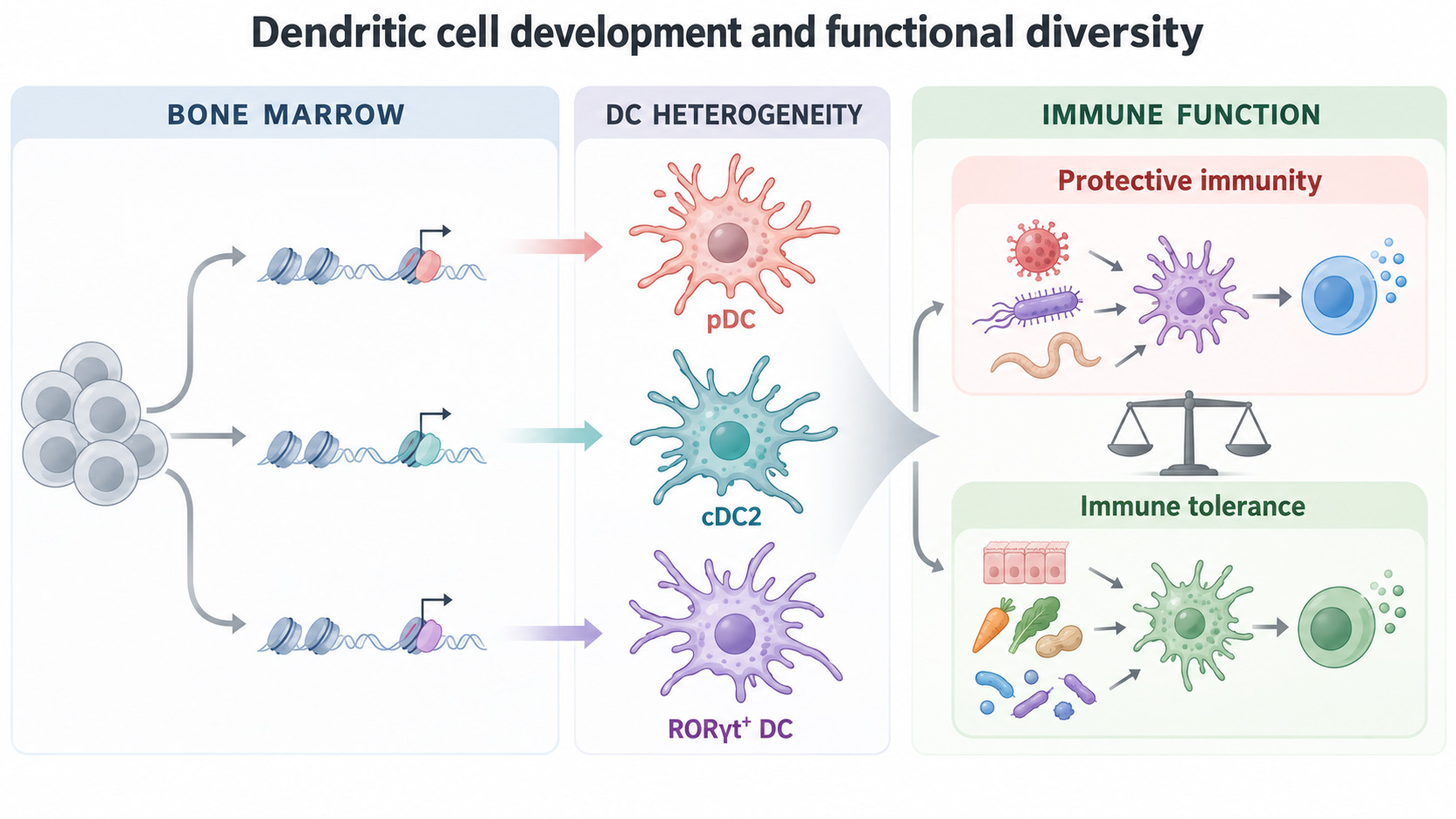
Dendritic cell development and functional heterogeneity
Dendritic cells (DCs) are a heterogeneous family of professional antigen-presenting cells that bridge innate and adaptive immunity. They detect changes in their environment, capture, process and present antigens, and guide the differentiation of T cells. Through these functions, DCs initiate protective responses against pathogens while also preventing harmful reactions to self, food-derived antigens and commensal microorganisms. These distinct functions are carried out by specialized DC subsets with unique developmental origins and functional properties. However, the molecular mechanisms that generate this diversity and determine the identity of individual DC populations remain poorly understood.
Our group investigates how transcription factors and epigenetic mechanisms control the commitment and specification of DC progenitors in the bone marrow. We are particularly interested in how transcription factors establish distinct developmental programs, alter chromatin accessibility and regulate the transition from progenitor cells to specialized DC subsets. Using genetic mouse models together with cellular, genomic and single-cell approaches, we aim to determine how these early developmental events generate the heterogeneous DC populations found in peripheral tissues.
Our research focuses on several related DC populations, including plasmacytoid DCs, pDC-like cells, cDC2 subsets and RORγt⁺ DCs. We study how their developmental origins and molecular programs influence their capacity to regulate T-cell responses, maintain immune tolerance and mediate immunity against pathogens. By linking lineage development with immune function, we aim to understand why particular DC subsets promote tolerance under some conditions but support inflammation or protective immunity under others. Ultimately, our work may reveal how disruptions in DC development or specialization contribute to infection, allergy, autoimmunity and chronic inflammatory disease.